
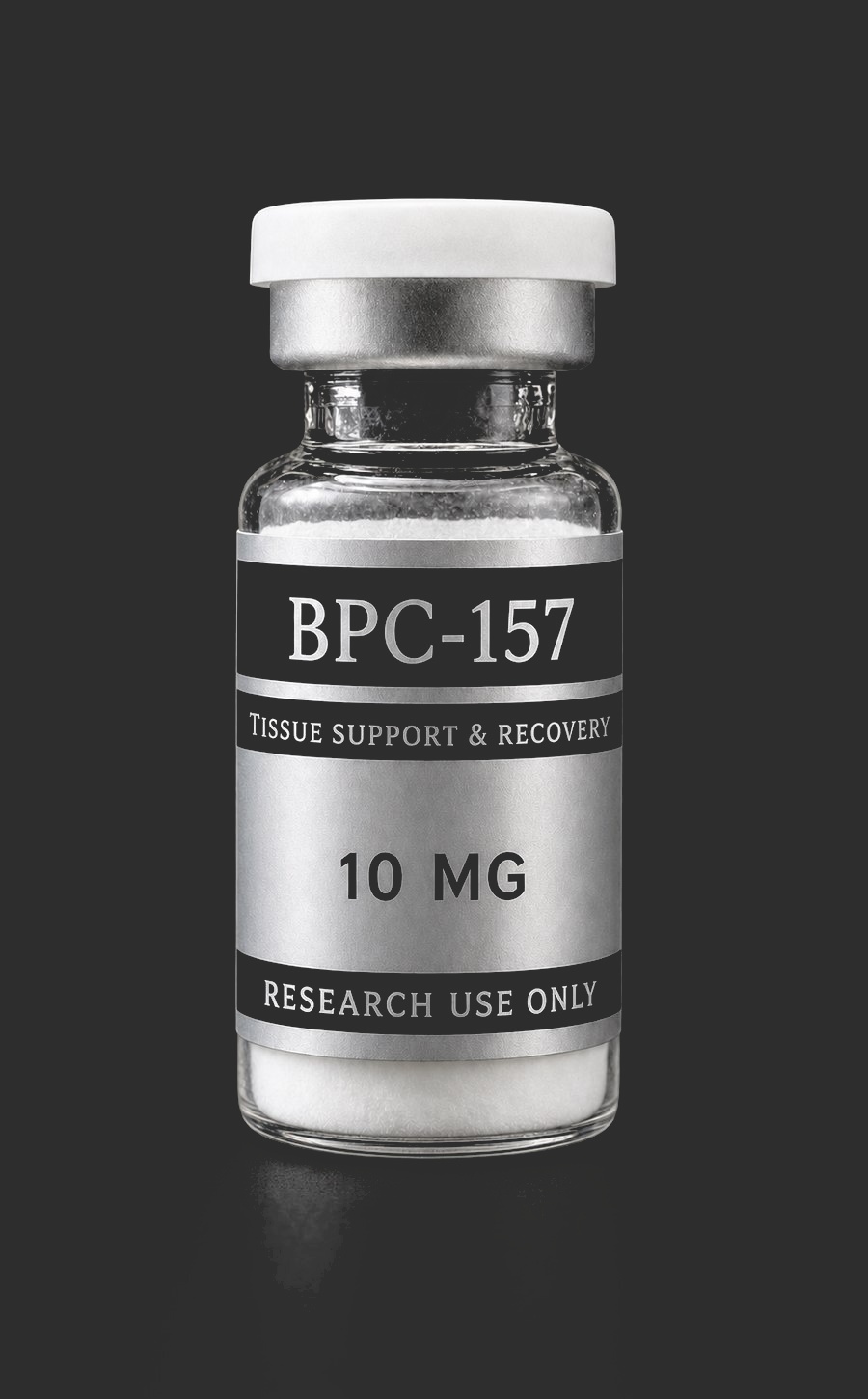
BPC-157
Also known as · Body Protection Compound-157 · PL 14736 · Bepecin · Pentadecapeptide BPC 157
- EvidencePreclinical
- CategoryTissue support & recovery
- RoutesubQ / IM
- Half-lifeShort (proline-stabilized)
- Form
- Lyophilized powder
- Purity
- ≥98% (HPLC)
- Molecular formula
- C62H98N16O22
- Molecular weight
- 1419.5 g/mol
- CAS number
- 137525-51-0
- Sequence
- GEPPPGKPADDAGLV
- COA
- Available on request
In stock
$44.99
For research use only. Not for human consumption. Buyers must be affiliated with a research institution.
01 / Research summary
What the literature reports
BPC-157 is a synthetic 15-amino-acid fragment of a larger cytoprotective protein originally isolated from human gastric juice by the Sikiric group at the University of Zagreb. Its unusually proline-rich sequence (five prolines in fifteen residues) confers stability against pepsin and gastric acid, which is atypical for peptides of this size.
Cellaire classifies BPC-157 as preclinical evidence. Over 300 animal papers document effects on tendon, ligament, gut, and vascular endothelium, with a 2025 PMC narrative review summarizing the mechanism as VEGFR2 activation and nitric-oxide-mediated angiogenesis. A phase-2 clinical trial in ulcerative colitis (as PL 14736) reported no toxicity. There are no published human dose-ranging trials for musculoskeletal indications, so no clinical dosing schedule is presented on this page.
02 / Reconstitution
Reconstitution reference
Illustrative unit math for a 10 mg vial reconstituted with 2 mL bacteriostatic water. This is not a dose recommendation.
03 / Overview
Molecular overview
BPC-157 (Body Protection Compound-157) is a synthetic pentadecapeptide with the sequence Gly-Glu-Pro-Pro-Pro-Gly-Lys-Pro-Ala-Asp-Asp-Ala-Gly-Leu-Val. It is a partial sequence of a larger ~40 kDa protein present in human gastric juice.
Because five of its fifteen residues are proline, the molecule resists chymotrypsin, pepsin, and low-pH degradation. This is the same feature that makes the peptide unusual to work with as a research chemical: it stays intact where most peptides would not.
Preclinical literature reports activity on the vascular endothelium (VEGFR2/Akt/eNOS pathway), fibroblast proliferation, and stabilization of the neuromuscular junction. The clinical translation is still limited to a single reported phase-2 trial in inflammatory bowel disease.
BPC-157 is not FDA-approved for any indication. In July 2026, the FDA Pharmacy Compounding Advisory Committee voted 8-6 to recommend allowing BPC-157 to be compounded, but the underlying safety findings from the FDA bulk-substance nomination remain on file.
04 / References